

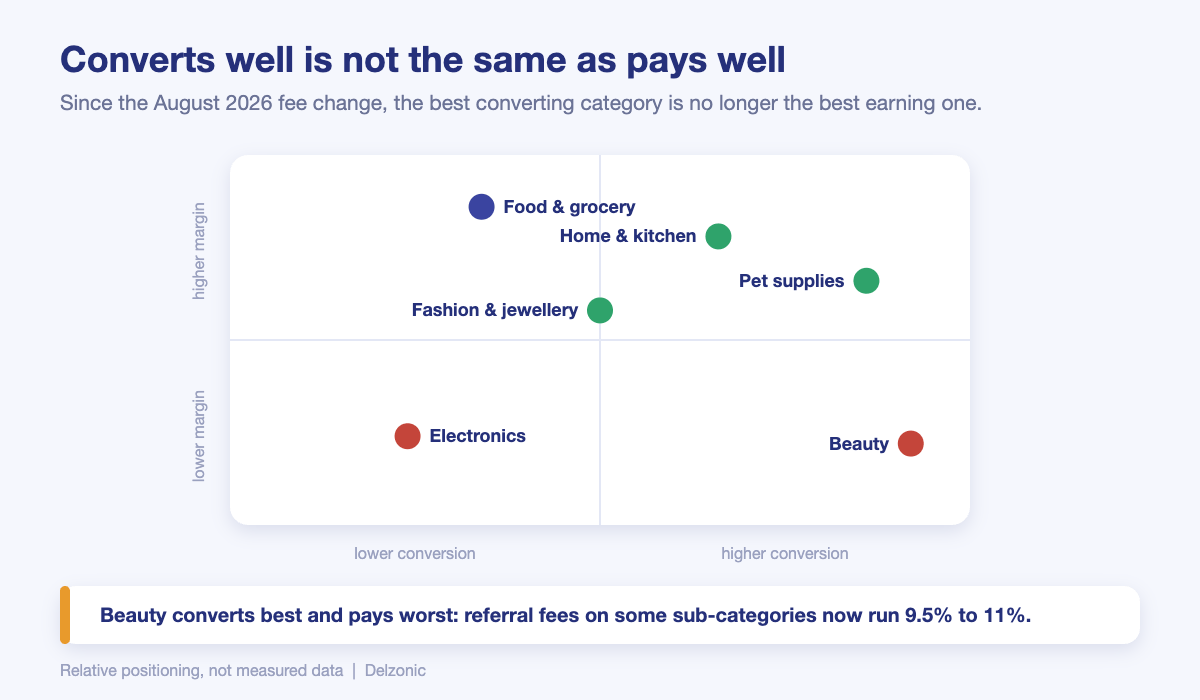
Short answer: Beauty and personal care, home and kitchen gadgets, pet supplies, and fashion accessories convert best on TikTok Shop, because each one demonstrates visibly in short-form video and sits in an impulse price band. But conversion rate alone stopped being the right metric in 2026. After the August referral fee increase pushed select beauty categories to 9.5% to 11%, the highest-converting category is no longer automatically the most profitable one.
What “best converting” actually means
Conversion rate is the share of people who view a product and then buy it. It is not the same as views, sales volume, or profit, and confusing them is the most common mistake in category selection.
| Metric | What it tells you | What it hides |
|---|---|---|
| Views | Reach and content appeal | Whether anyone bought |
| Conversion rate | How persuasive the listing is | Whether the margin survives |
| Sales volume | Total demand | How many sellers are splitting it |
| Net margin | What you actually keep | Nothing, this is the one that counts |
A category can pull enormous views and convert badly, which is common in entertainment-adjacent products. It can also convert brilliantly and still lose money once fees, affiliate commission and returns are applied. Both failure modes are avoidable if you look past a single number.
Categories that tend to convert well, and why
Beauty and personal care
Consistently the strongest converter on the platform. The reasons are structural: results are visible on camera, the price point sits in impulse territory, and the category has an enormous existing creator base producing content anyway.
The 2026 caveat: select beauty and personal care sub-categories now carry referral fees of 9.5% to 11% rather than the standard 8%. Stack that on the 15% to 20% affiliate commission this category typically requires to attract creators, and roughly a third of your sale price is gone before product cost. Beauty still converts best. It no longer automatically pays best.
Home and kitchen gadgets
Excellent converters because they solve a visible, specific problem in a fifteen-second demonstration. The “I did not know I needed this” reaction is precisely what drives impulse purchase.
These sit in standard fee categories, which after the 2026 changes makes them relatively more attractive than they were against beauty.
Pet supplies
High conversion and unusually high repeat purchase. Pet owners buy emotionally, buy often, and are less price-sensitive than in most categories. Content is easy because the pet does the work.
Fashion accessories and jewellery
Strong converters with good margin structure. Low unit cost, high perceived value, and they film well. Jewellery in particular has historically carried favourable referral rates.
Categories that usually convert slower
- High-ticket electronics. Buyers research and compare before purchasing, which breaks the impulse loop that TikTok Shop depends on.
- Anything requiring sizing confidence. Footwear and fitted clothing convert lower and return higher, and returns damage your Shop Performance Score as well as your margin.
- Commodity items with no demonstration. If there is nothing to show, there is no content, and without content there is no distribution.
- Heavily regulated categories. Supplements and health products face claim restrictions that limit what your content can say, which caps conversion.
None of these are unsellable. They simply need a different approach, usually higher margin per unit to offset lower conversion.
The spread inside a category beats the gap between categories
A well-executed listing in a slow category outperforms a poor listing in the best-converting one every time. Choosing beauty does not make you convert at the beauty average, it puts you against operators far more established than a new shop.
What actually makes a category convert
Strip away the category labels and the same four factors decide it:
- Demonstrability. Can the benefit be shown, not described, in under fifteen seconds?
- Impulse price band. Broadly £10 to £40 or $15 to $50. Above that, buyers leave to research.
- Low decision risk. No sizing, no compatibility questions, no meaningful chance of being wrong.
- Existing creator supply. Categories where creators already make content have a built-in distribution advantage.
Any product meeting all four converts well regardless of which category it nominally sits in. That is more useful than a category ranking, because it lets you evaluate individual products rather than betting on an average.
Category data is a starting point, not a verdict
Category-level conversion rates are averages across thousands of listings with wildly different quality, pricing and content. The spread inside any category is far larger than the gap between categories.
Put concretely: a well-executed listing in a slow category will outperform a poor listing in the best-converting category, every time. Choosing beauty does not make you a beauty seller who converts at the beauty average. It puts you in a competitive field where the average is dragged up by operators far more established than a new shop.
The decision you actually need to make is at product level, not category level. That means checking real sales velocity, real competitor count, and real margin for the specific item you are considering. Our complete guide to TikTok Shop product research covers the six-signal screening process.
The Delzonic Chrome extension shows live sales and competition data on individual TikTok Shop listings while you browse, so you can check whether a specific product is converting rather than assuming it inherits its category average.
Frequently asked questions
Which TikTok Shop category converts best overall?
Beauty and personal care consistently leads on conversion rate, followed by home and kitchen gadgets, pet supplies, and fashion accessories. Since the 2026 fee changes, beauty’s higher referral rate means it no longer automatically delivers the best net margin.
Do high-view categories always convert well?
No. Views measure content appeal, conversion measures purchase intent. Entertainment-adjacent products routinely generate large view counts with weak conversion.
Should I avoid slower-converting categories entirely?
No. Lower conversion is workable if margin per unit is high enough and competition is thinner. Slower categories are often less crowded for exactly that reason.
Does a strong category guarantee sales?
No. Category sets the baseline. Product choice, content quality, pricing and creator relationships decide whether you beat that baseline or fall well below it.
How do I check whether a specific product converts, not just its category?
Look at that product’s recent sales velocity against its seller count, and check whether existing videos for it are driving engagement. Category averages cannot tell you this.
Pro tip
Judge a product on the four underlying factors rather than its category label: can the benefit be shown in fifteen seconds, is it in the impulse price band, is the decision low-risk, and do creators already make content in that space.
The bottom line
Category selection narrows the field. It does not decide the outcome. The most useful thing you can take from conversion data is the four underlying factors, demonstrability, price band, decision risk and creator supply, and then apply them product by product.
And since 2026, run the margin math before you commit. The best-converting category and the most profitable category are no longer the same answer. Delzonic gives you the product-level sales and competition data to make that call properly. Start free, and upgrade for historical trends.