
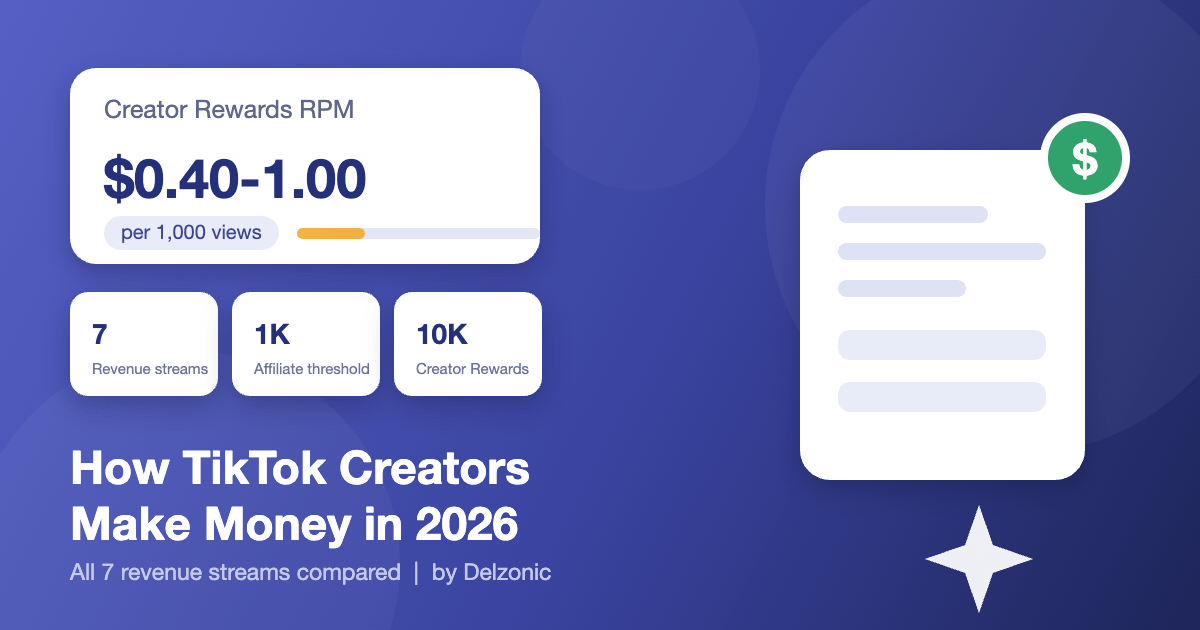
Short answer: TikTok creators make money through seven main routes in 2026: the Creator Rewards Program, TikTok Shop affiliate commission, LIVE gifts, brand deals, Pulse ad revenue share, Series paid content, and selling their own products. Creator Rewards pays roughly $0.40 to $1.00 per 1,000 qualified views, which means view-based income alone is small for most people. The creators earning real money are almost always earning it from affiliate commission or brand deals, not from the platform paying them for views.
The seven ways to make money on TikTok
| Method | Follower requirement | Realistic earning power |
|---|---|---|
| Creator Rewards Program | 10,000 | Low to moderate |
| TikTok Shop affiliate | 1,000 to 5,000 | High |
| Brand deals | None official | High |
| LIVE gifts | 1,000 | Moderate, highly variable |
| Pulse ad revenue share | 100,000 | Moderate |
| Series paid content | 10,000 | Moderate, niche dependent |
| Selling your own products | None | Highest ceiling |
1. Creator Rewards Program
This is what most people mean when they ask whether TikTok pays you. It replaced the old Creator Fund and pays substantially better, but the numbers still surprise people.
Requirements: 10,000 followers, 100,000 video views in the last 30 days, aged 18 or over, based in an eligible country, an account in good standing, and original videos at least 60 seconds long.
How it pays: On qualified views, meaning authentic For You feed views lasting five seconds or longer from unique accounts. A video must reach 1,000 qualified views before it earns anything. Payment is roughly qualified views divided by 1,000, multiplied by your RPM.
What RPM to expect: Typical 2026 RPM sits between $0.40 and $1.00 per 1,000 qualified views, with strong niches and high retention reaching $2.00 or more. Finance, tech, and business content earns materially more than entertainment or dance content, because advertisers pay more to reach those audiences.
Run the maths before you build a strategy around it. A video with 500,000 qualified views at $0.60 RPM earns about $300. That is a genuinely viral video for most accounts, producing less than a single mid-tier brand deal. Creator Rewards is a useful floor, not a career.
2. TikTok Shop affiliate commission
This is where most creators who earn seriously on TikTok actually earn it, and the follower requirement is far lower than Creator Rewards at roughly 1,000 to 5,000 depending on your market.
You promote a seller’s product, a viewer buys through your video or showcase, and you take a commission on the sale. Commission rates are set by the seller and typically run from around 5% up to 20% or more, with newer sellers and unproven products offering the highest rates to attract creators.
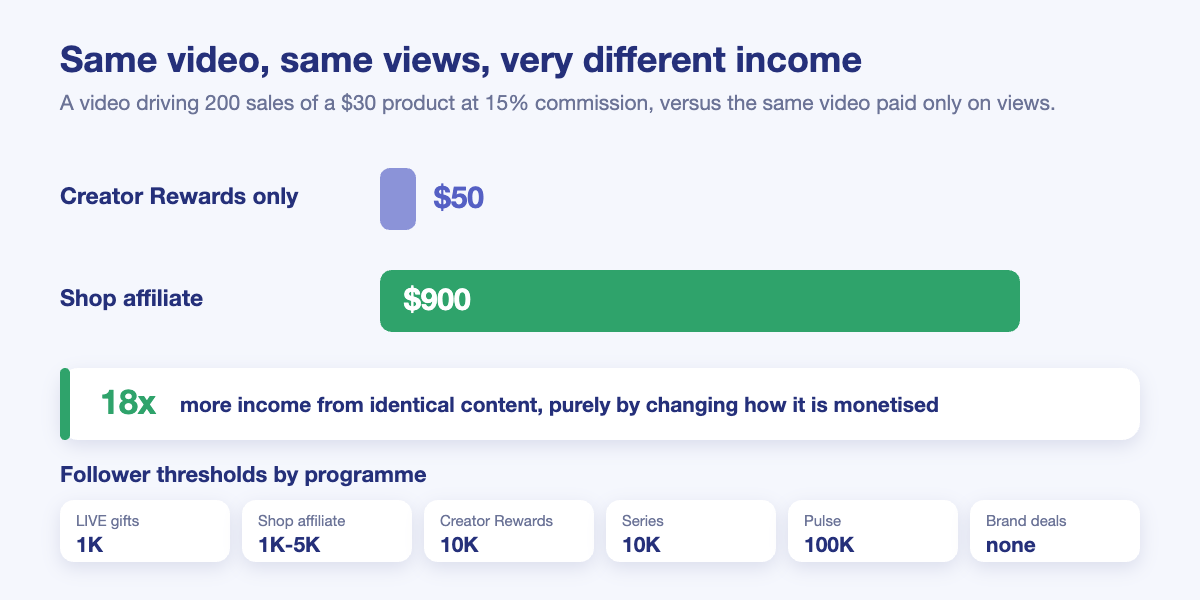
The economics are structurally better than view-based pay. A video that drives 200 sales of a $30 product at 15% commission earns $900. The same video monetised only through Creator Rewards might earn $50. Same content, same views, eighteen times the income.
The catch is that it depends entirely on promoting products people actually want. A creator with modest reach promoting a genuinely in-demand product outearns a creator with large reach promoting something nobody is buying. Our guides on finding products to promote and current commission rates cover how to pick.
If you are under the follower threshold, our guide to starting as a TikTok Shop affiliate without followers covers the routes available.
3. Brand deals and sponsored content
Brand deals have no official follower threshold, which makes them available earlier than most creators assume. Brands increasingly pay for audience fit rather than audience size, and a 15,000-follower account with a tightly defined niche can charge more than a 200,000-follower general entertainment account.
Rates vary enormously. A rough working range for mid-sized creators is $100 to $500 per 10,000 followers per sponsored video, adjusted heavily by niche, engagement rate, and usage rights. Finance, B2B, and health niches command multiples of entertainment rates.
Importantly, participating in Creator Rewards does not restrict brand deals, sponsored content, or any other monetisation. These stack.
4. LIVE gifts
Available from 1,000 followers. Viewers buy coins and send virtual gifts during live streams, which you convert to money. Income is highly variable and depends far more on stream frequency and audience relationship than on follower count.
The realistic picture is that LIVE gifting rewards consistency brutally. Creators who stream several times a week build a regular audience that gifts habitually. Occasional streamers earn close to nothing. It is also the most time-intensive method per dollar earned, which is why many creators use LIVE for selling rather than for gifts. Our LIVE selling guide covers that route.
5. Pulse ad revenue share
Requires 100,000 followers. Pulse places your content adjacent to premium advertising and shares the revenue. It is a genuine income stream at scale but the threshold puts it out of reach for most creators, and it is best understood as a bonus on top of a strategy rather than the strategy.
6. Series paid content
Requires 10,000 followers. Series lets you sell collections of premium content directly to your audience, priced by you. It works well for instructional and skill-based niches where viewers want depth that free content does not provide, and poorly for entertainment where the audience has no reason to pay.
7. Selling your own products
No threshold, highest ceiling, most work. Instead of taking 15% commission promoting somebody else’s product, you keep the margin on your own. A creator who moves the same volume as an affiliate but sells their own product typically earns three to five times more from identical content.
This is the natural progression for creators who find a product category their audience reliably buys. Many start as affiliates specifically to test what converts before committing money to inventory, which is a sensible sequence. Our guide to selling on TikTok Shop covers the setup.
Niche decides the ceiling
Finance, tech and business content earns materially more per thousand views than entertainment or dance, because advertisers pay more to reach those audiences. No amount of effort closes that gap.
How much do TikTok creators actually make?
Honest answer: the distribution is extremely skewed, and averages are misleading. A more useful way to think about it is by monetisation mix.
| Creator profile | Primary income | Typical monthly range |
|---|---|---|
| 10K to 50K, views only | Creator Rewards | $20 to $200 |
| 10K to 50K, affiliate focused | Shop commission | $300 to $3,000 |
| 50K to 250K, mixed | Affiliate plus brand deals | $1,500 to $10,000 |
| 250K+, mixed | Brand deals plus Pulse plus affiliate | $5,000 to $50,000+ |
These are ranges, not promises, and the variance within each band is larger than the gap between bands. The consistent pattern is that two accounts in the same follower bracket earning wildly different amounts are almost always separated by monetisation mix rather than by content quality.
What separates creators who earn from creators who do not
Three things, in order of impact.
Monetisation mix. Creators relying on Creator Rewards alone are competing for the smallest pool of money on the platform. Adding affiliate commission typically multiplies income without requiring more views.
Niche economics. Some audiences are worth more than others to advertisers and to sellers. A tech reviewer and a dance creator with identical follower counts do not have identical earning potential, and no amount of effort closes that gap. Choosing the niche is choosing the ceiling.
Product selection. For anyone monetising through Shop, this is the whole game. Promoting a product with real demand and reasonable competition outperforms promoting a saturated one by a margin that content quality cannot make up.
That last point is the one creators control most directly and research least. The Delzonic Chrome extension shows live sales volume and competition data on TikTok Shop products while you browse, so you can check whether something is actually selling before you build content around it. Making a video for a product nobody is buying costs the same as making one for a product everybody is buying.
Frequently asked questions
How many followers do you need to make money on TikTok?
1,000 for LIVE gifts and TikTok Shop affiliate in most markets, 10,000 for Creator Rewards and Series, 100,000 for Pulse. Brand deals have no official minimum.
How much does TikTok pay per 1,000 views?
Through Creator Rewards, roughly $0.40 to $1.00 per 1,000 qualified views for most creators, reaching $2.00 or more in high-value niches. Qualified views are For You feed views of five seconds or longer from unique accounts.
Do videos under a minute earn money?
Not through Creator Rewards, which requires original videos of at least 60 seconds. Shorter videos can still earn through affiliate commission, brand deals, and driving sales.
Can you do Creator Rewards and brand deals at the same time?
Yes. The Creator Rewards Program does not restrict brand deals, sponsored content, or other monetisation.
What is the fastest way to start earning?
TikTok Shop affiliate, because the follower threshold is the lowest of the paid programmes and earnings scale with sales rather than with views.
Pro tip
If you are under the Creator Rewards threshold, do not wait for it. TikTok Shop affiliate opens at roughly 1,000 followers and pays on sales rather than views, so it is usually the first programme worth joining.
The bottom line
TikTok pays creators poorly for views and well for sales. Creators who understand that reorganise around commission and brand deals early, and the ones who do not spend years chasing a view count that was never going to pay much.
If you are monetising through TikTok Shop, what you promote matters more than how many followers you have. Delzonic shows you which products are actually selling and how crowded the competition is, so you build content around demand rather than guessing. Start free to explore live product data, and upgrade for historical trends and deeper analysis.
Where else the same content can earn
TikTok pays quickly and forgets quickly. YouTube pays slowly and keeps paying. Our comparison of TikTok Shop and YouTube Shopping covers the creator thresholds, commission ranges, and why the content lifespan gap matters more than the rates.