
TikTok Shop Fee Increase 2026: The New 8% Referral Rate and What It Does to Your Margins
Short answer: On 4 August 2026, TikTok Shop raised the standard US referral fee for most non-food categories from 6% to 8%. Selected beauty and electronics sub-categories now sit between 9.5% and 11%. Food and grocery stayed near 5%. For a seller doing $50,000 a month in a standard category, that two-point move costs $1,000 a month in fees that previously fell to the bottom line.
What exactly changed on 4 August 2026?
TikTok Shop increased the referral fee it charges US sellers on each order. The referral fee is the platform commission taken from the order value, separate from payment processing, affiliate commission, and fulfilment costs.
| Category | Before | After 4 Aug 2026 | Change |
|---|---|---|---|
| Most non-food categories | 6% | 8% | +2.0 pts |
| Select beauty and personal care | 6% | 9.5% to 11% | +3.5 to 5.0 pts |
| Select electronics sub-categories | 6% | 9.5% to 11% | +3.5 to 5.0 pts |
| Food and grocery | ~5% | ~5% | No change |
Rates vary by specific sub-category, so confirm your exact rate in Seller Center rather than assuming the headline number applies to you. The categories that moved most are the ones with the highest GMV on the platform, which is not a coincidence.
How much does this actually cost you?
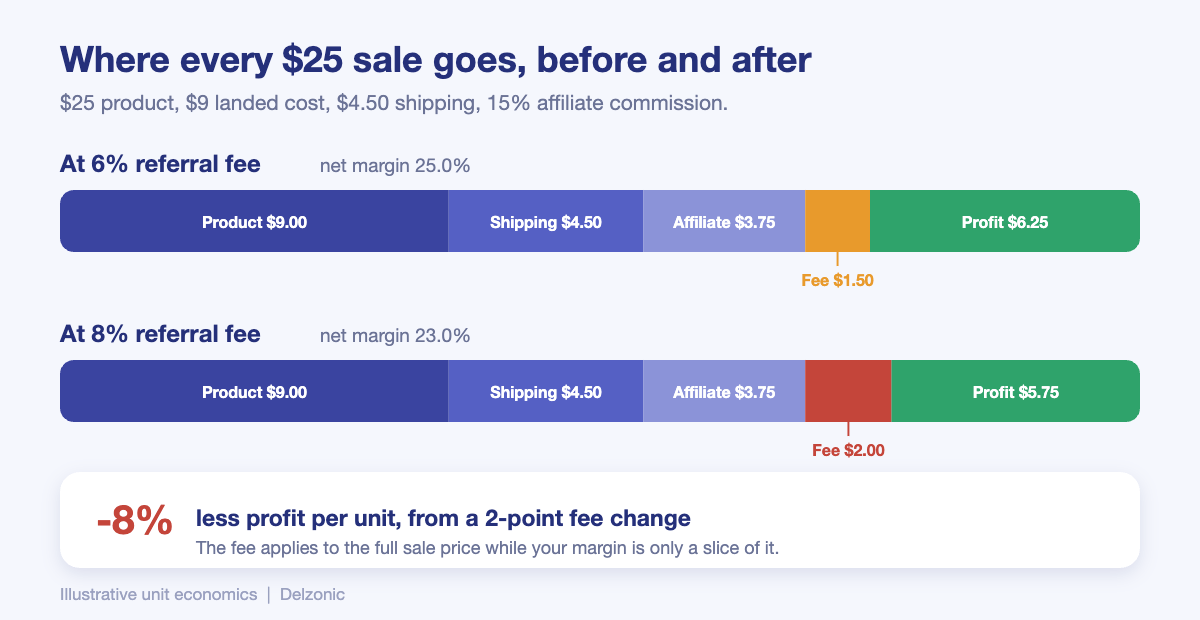
The percentage sounds small. The effect on profit is not, because the fee comes out of revenue while your costs stay fixed.
Take a $25 product in a standard category with a $9 landed cost:
| Line | At 6% | At 8% |
|---|---|---|
| Sale price | $25.00 | $25.00 |
| Referral fee | -$1.50 | -$2.00 |
| Landed product cost | -$9.00 | -$9.00 |
| Shipping | -$4.50 | -$4.50 |
| Affiliate commission at 15% | -$3.75 | -$3.75 |
| Profit per unit | $6.25 | $5.75 |
| Net margin | 25.0% | 23.0% |
That is an 8% reduction in profit per unit from a 2-point fee change. The leverage runs against you because the fee applies to the full sale price while your margin is only a slice of it. The thinner your margin was, the harder this lands. A seller who was running at 12% net is now at 10%, which is a sixth of their profit gone.
Which categories got hit hardest?
Beauty and personal care is the worst affected. It was already the most competitive vertical on TikTok Shop, it carries the highest affiliate commission expectations, and it now carries a referral fee up to 11%. Stack an 11% referral fee on a 20% affiliate commission and roughly a third of your sale price is gone before product cost.
Electronics sub-categories in the raised band face a different problem. Electronics typically run on thinner percentage margins than beauty because the price points are higher and buyers compare more aggressively. A 5-point fee increase on a low-margin category can eliminate profitability outright.
Food and grocery sellers are the clear winners here, having avoided the increase entirely.
Is there still a new seller discount?
Yes, and it survived the increase. New sellers who make their first sale within 60 days of completing onboarding get a discounted 3% referral rate for 30 days. The discount activates within 48 hours of your first order, and standard category rates apply once the 30 days end.
The practical implication is that the discount window is now worth substantially more than it was before August. A 3% rate against an 8% standard rate is a five-point advantage. If you are launching, do not waste that month testing. Have your inventory, content, and affiliate outreach ready before your first sale triggers the clock, because the window starts on your first order rather than when you feel prepared.
What the increase costs at your volume
Two points of referral fee is roughly $1,000 a month at $50,000 GMV, $4,000 at $200,000, and $20,000 at $1 million. It never announces itself. It shows up as a slightly worse month that is easy to blame on something else.
How should sellers respond?
1. Recalculate every product, not just the marginal ones
Products that were comfortably profitable at 6% can still be profitable at 8%. Products that were marginal are now losing money. Run the numbers per SKU rather than assuming a blanket price rise fixes it. Our TikTok Shop profit margin guide covers the full cost stack.
2. Reprice deliberately, not reflexively
Raising prices by 2% to offset a 2-point fee does not work, because the fee applies to the new higher price too. To hold profit per unit on the $25 example above you need roughly a 2.2% increase, and you need demand at that price to hold. Test rather than assume.
3. Renegotiate affiliate commission
Affiliate commission is the largest controllable line for most sellers and it is negotiable in a way the referral fee is not. Dropping from 20% to 17% on a product recovers more than the entire fee increase. The risk is reduced creator interest, so move selectively on products where you have organic demand rather than across the board.
4. Shift mix toward categories that did not move
If part of your catalogue sits in food and grocery, the relative economics just improved. Sellers with flexibility on what they list should be looking at where the fee structure now favours them.
5. Raise average order value
Bundles and multi-packs spread fixed costs like shipping across a larger order while the referral fee stays proportional. This is one of the few levers that improves margin without requiring a price increase per unit.
Does this change which products are worth selling?
Yes, and this is the part most sellers will get wrong. The fee increase does not reduce demand, it raises the minimum viable margin. Products that only worked because the fee was low are now off the table, and the gap between a good product choice and a mediocre one just widened.
Concretely, the threshold moved. A product needs roughly two additional points of gross margin to deliver the same net profit it delivered in July. Low-ticket, high-competition items in the raised categories are the most exposed, because they combine thin margins with the highest fee bands.
This makes pre-purchase research more valuable than it was a month ago. The Delzonic Chrome extension surfaces live sales volume and competition data directly on TikTok Shop listings, so you can check whether a category still supports the margin you need before you commit inventory to it. Guessing was survivable at 6%. It is expensive at 8%.
Frequently asked questions
Is the TikTok Shop referral fee now 8% for everyone?
No. 8% is the standard rate for most US non-food categories. Selected beauty and electronics sub-categories run 9.5% to 11%, and food and grocery remain around 5%. Check Seller Center for your specific sub-category.
Does the referral fee apply before or after discounts?
The referral fee is calculated on the order value the customer actually pays, so seller-funded discounts reduce the fee base along with your revenue.
Is the referral fee the only fee TikTok Shop charges?
No. Referral fee sits alongside payment processing, any affiliate commission you offer, and fulfilment costs if you use Fulfilled by TikTok. Our full TikTok Shop fee breakdown covers each line.
Did UK and Southeast Asia rates change too?
This increase applied to US rates. UK and Southeast Asia operate on separate schedules, so confirm your regional rate directly in Seller Center.
Can I avoid the increase by moving categories?
Only if the product genuinely belongs in the other category. Miscategorising a listing to secure a lower fee is a policy violation and will cost you far more through your Account Health Rating than the fee saving is worth.
Pro tip
Raising your price by two percent does not offset a two-point fee rise, because the fee applies to the new higher price too. On the $25 example you need roughly 2.2% to hold profit per unit, and you need demand to survive it.
The bottom line
A two-point fee increase is not an emergency, but it is a real reduction in profit that will not announce itself. It shows up quietly as a slightly worse month, and sellers who do not recalculate will keep running products that stopped working in August.
Reprice deliberately, renegotiate affiliate rates where you have leverage, and raise your bar for what counts as a viable product. Delzonic gives you the sales and competition data to set that bar with numbers rather than instinct. Start free to explore live product data, and upgrade when you need historical trends and deeper category analysis.
Check a product against the new rate
To see what the 8% rate does to a specific product rather than the example above, run it through our free landed cost calculator, which applies your category rate alongside duty, freight and fulfilment.