
Short answer: Shop Performance Score (SPS) is TikTok Shop’s 0 to 5 quality rating, built from six metrics across product satisfaction, fulfilment, and customer service. It is scored against category-specific benchmarks and updated frequently. Fall below 3.0 and TikTok can pause or remove benefits including affiliate access, campaign eligibility, and faster settlement. Most sellers who lose reach without explanation are losing it here.
What is Shop Performance Score?
SPS measures how good your shop is to buy from. It is separate from Account Health Rating, which measures policy compliance. AHR can get your shop closed. SPS quietly decides how much distribution and how many platform privileges you get while your shop stays open.
The score runs 0 to 5 and moves continuously as recent orders come in. It is not a static grade, and it is benchmarked by category rather than platform-wide, so your target is what good looks like among sellers of similar products.
The six metrics that make up SPS
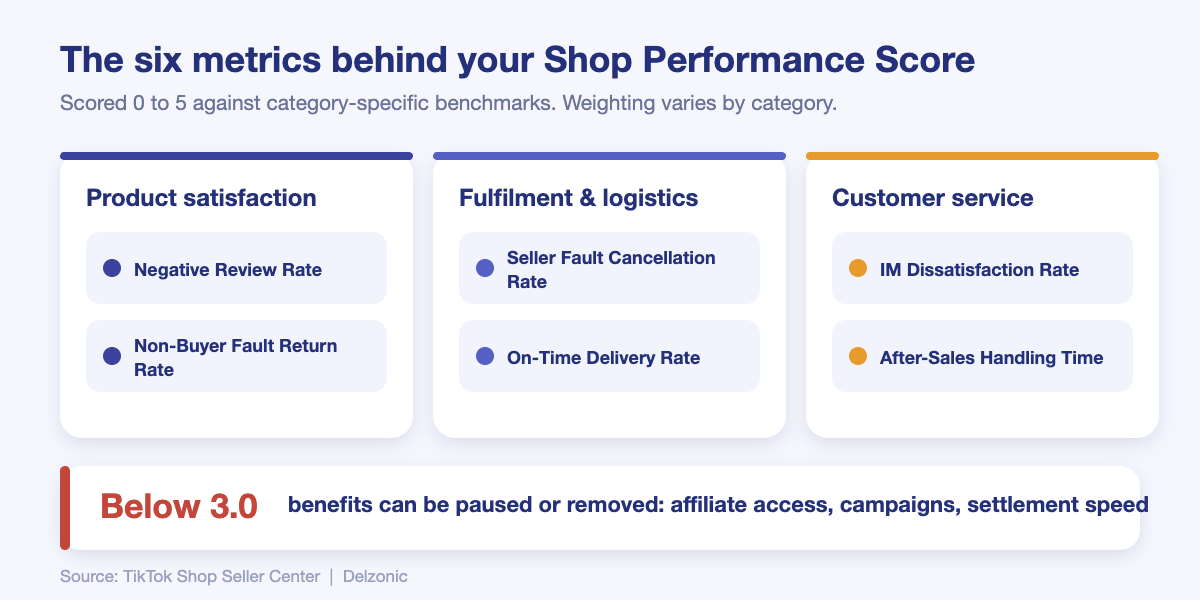
SPS is built from six metrics grouped into three dimensions. Weighting differs by category, so the same metric can matter more in beauty than in home goods.
| Dimension | Metric | What it tracks |
|---|---|---|
| Product satisfaction | Negative Review Rate | Share of orders drawing low-star reviews |
| Non-Buyer Fault Return Rate | Returns caused by the product, not buyer preference | |
| Fulfilment and logistics | Seller Fault Cancellation Rate | Orders you cancelled, usually stockouts |
| On-Time Delivery Rate | Whether orders arrive within the promised window | |
| Customer service | IM Dissatisfaction Rate | Buyer dissatisfaction with your message responses |
| After-Sales Handling Time | How long you take to resolve post-purchase issues |
What changed in the 2026 SPS update
TikTok reworked the metric set, and the changes reward different behaviour than the old system did.
- IM Dissatisfaction Rate and After-Sales Handling Time replaced 24-Hour Response Rate and Customer Complaint Rate. The old metrics rewarded speed. You could hit a 24-hour response target with a useless reply. The new metrics measure whether the buyer was actually satisfied and whether the issue was actually resolved. Fast and unhelpful now scores worse than slower and effective.
- On-Time Delivery Rate replaced Late Dispatch Rate. This moves responsibility downstream. You are no longer judged on getting the parcel out of your door, you are judged on it arriving when promised. Carrier performance is now your problem, which makes carrier choice and realistic delivery windows a scoring decision.
- Product satisfaction now measures over 60 days instead of 90. Problems age out faster, so a bad month recovers sooner. It also means a bad month hurts faster.
- Category-specific benchmarks. You are compared against sellers in your category rather than against a platform-wide average.
What happens when your SPS drops?
The consequences are graduated and mostly invisible until you go looking for them. TikTok states that some benefits can be paused or removed when a score falls below 3.0. In practice sellers report:
- Reduced organic reach. Content tied to a weak shop gets distributed less aggressively. This is the effect most sellers notice first and misdiagnose as an algorithm change.
- Affiliate access restrictions. Creators see shop quality signals. A weak score makes it harder to recruit good affiliates, and can restrict programme access outright.
- Campaign ineligibility. Platform promotions and seasonal campaigns carry SPS thresholds. Missing Q4 campaigns because of a 2.8 score is an expensive way to learn this.
- Slower settlement. Payout speed can be tied to shop performance, which turns a quality problem into a cash flow problem.
The reason this catches people out is that nothing fails loudly. Your shop stays open, your listings stay live, and your sales just quietly decline. If you have been asking why your TikTok Shop stopped getting sales, SPS is one of the first places to look.
The metric change that catches sellers out
On-Time Delivery Rate replaced Late Dispatch Rate, which moved carrier performance onto your scorecard. Sellers who kept the same promised delivery windows after that change saw scores fall without doing anything differently themselves.
How to fix a falling SPS
Set delivery windows you can actually hit
Now that On-Time Delivery Rate replaced Late Dispatch Rate, promising a three-day delivery you hit 70% of the time is worse than promising five days you hit 98% of the time. The metric is the promise you set against the outcome you deliver, so lowering the promise is a legitimate fix.
Fix the product, not the reviews
Negative Review Rate and Non-Buyer Fault Return Rate both point at product quality. Sellers waste effort trying to suppress reviews when the return reasons are telling them exactly what is wrong. Read the non-buyer-fault return reasons directly. They are the cheapest product feedback you will ever get.
Resolve rather than respond
Under IM Dissatisfaction Rate, a fast non-answer is scored as a failure. Give the buyer a decision, not an acknowledgement. “We are looking into this” closes nothing and costs you twice, once on dissatisfaction and once on handling time.
Stop overselling inventory
Seller Fault Cancellation Rate is almost always a stock accuracy problem. Buffer stock levels on fast-moving items and pull listings before they go negative rather than after.
Prioritise by category weighting
Because weighting is category-specific, the same effort produces different returns depending on what you sell. Check which metrics carry the most weight for your category in Seller Center and fix those first.
Can you appeal an SPS metric?
Yes. If a metric was affected by something outside your control, or you have evidence the responsibility was not yours, you can appeal directly in Seller Center without going through support. The flow is:
- Submit the appeal with evidence in Seller Center.
- TikTok moderation reviews, typically around three business days.
- If approved, the metric is corrected in roughly one business day.
- Your SPS updates automatically.
Carrier failures on delivery, buyer-fault returns miscoded as seller-fault, and platform outages affecting response time are the appeals that most often succeed. Keep carrier tracking records, because that is the evidence that decides delivery appeals.
SPS and product choice
Two of the six metrics are product quality metrics, and a third is driven by whether you can fulfil reliably. That means a meaningful share of your score is decided before you make a single sale, at the point you choose what to sell and who to source it from.
Products with high defect rates, sizing inconsistency, or a gap between the marketing and the item generate negative reviews and non-buyer-fault returns no matter how well you run customer service. Crowded categories full of near-identical low-cost listings are where this concentrates.
The Delzonic Chrome extension shows live sales and competition data on TikTok Shop listings while you browse, so you can see how saturated a category is and how existing listings are actually performing before you commit. Choosing a product that does not generate returns is cheaper than managing the returns it generates.
Frequently asked questions
What is a good TikTok Shop Performance Score?
Above 4.0 is comfortable, and 3.0 is the line below which benefits can be paused or removed. Because benchmarks are category-specific, compare against your category rather than a universal target.
How often does SPS update?
Frequently, based on recent order data. Product satisfaction is now assessed over a 60-day window rather than 90, so changes surface faster than they used to.
Is SPS the same as Account Health Rating?
No. SPS measures service and product quality on a 0 to 5 scale. AHR measures policy compliance on a 0 to 1,000 scale and can result in deactivation. You can score badly on one and well on the other.
Does a low SPS affect my ads?
It can affect campaign eligibility and organic distribution, which changes what your paid traffic is working against even where ad delivery itself continues.
How long does it take to recover an SPS score?
Product satisfaction metrics move on a 60-day window, so meaningful recovery generally takes weeks of clean orders rather than days. Fixing the underlying cause early matters more than any single corrective action.
Pro tip
Promise a delivery window you hit 98% of the time rather than a faster one you hit 70% of the time. On-Time Delivery Rate scores the promise you set against the outcome you deliver, so lowering the promise is a legitimate fix.
The bottom line
SPS is the score that decides how much reach you get, and it fails silently. No warning email arrives when your distribution starts tapering, so the sellers who manage it are the ones who check it deliberately rather than the ones who wait to be told.
Check it weekly, appeal metrics that were not your fault, and pick products that do not generate returns in the first place. Delzonic gives you the sales and competition data to make that choice with evidence. The free plan covers live product data, and paid plans add historical trends and deeper category analysis.