
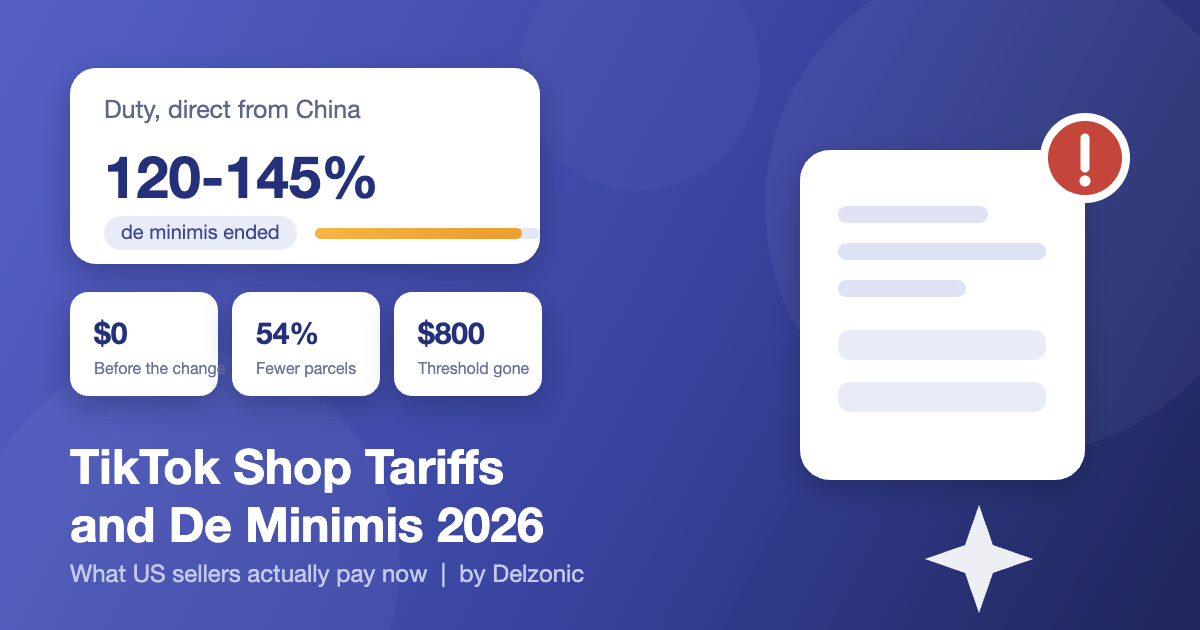
Short answer: The $800 de minimis exemption that let low-value parcels enter the US duty-free is gone. It ended for China and Hong Kong on 2 May 2025, extended to all countries on 29 August 2025, and the suspension was continued by executive order on 20 February 2026. Small packages shipped directly from China now face duties in the range of 120% to 145%, or a flat fee of around $100 per item depending on the shipping method. For TikTok Shop sellers, direct-from-China fulfilment is no longer economically viable at low price points.
What was de minimis and why did it matter?
De minimis was a customs rule that let shipments valued under $800 enter the United States without duties and with minimal paperwork. It was the invisible foundation under a large share of low-cost ecommerce.
If you dropshipped from a Chinese supplier straight to a US customer, de minimis is why that $12 phone case arrived without a customs bill. The parcel was under $800, so it passed through duty-free. That single rule made it possible to compete on price with domestic sellers while carrying no inventory.
Removing it did not raise costs slightly. It removed the structural advantage that the entire direct-from-China model was built on.
What is the current situation in 2026?
| Date | What happened |
|---|---|
| 2 May 2025 | De minimis eliminated for China and Hong Kong |
| 29 August 2025 | Elimination extended to all countries |
| 20 February 2026 | Suspension continued by executive order following the Supreme Court ruling on IEEPA tariff authority |
| Q2 2026 | Sub-$800 parcel volume into the US down roughly 54% |
The scale of the change is easy to underestimate. Approximately 740 million parcels a year disappeared from the US customs flow within four months of full elimination. That is not a market adjusting, that is a channel closing.
What does it actually cost now?
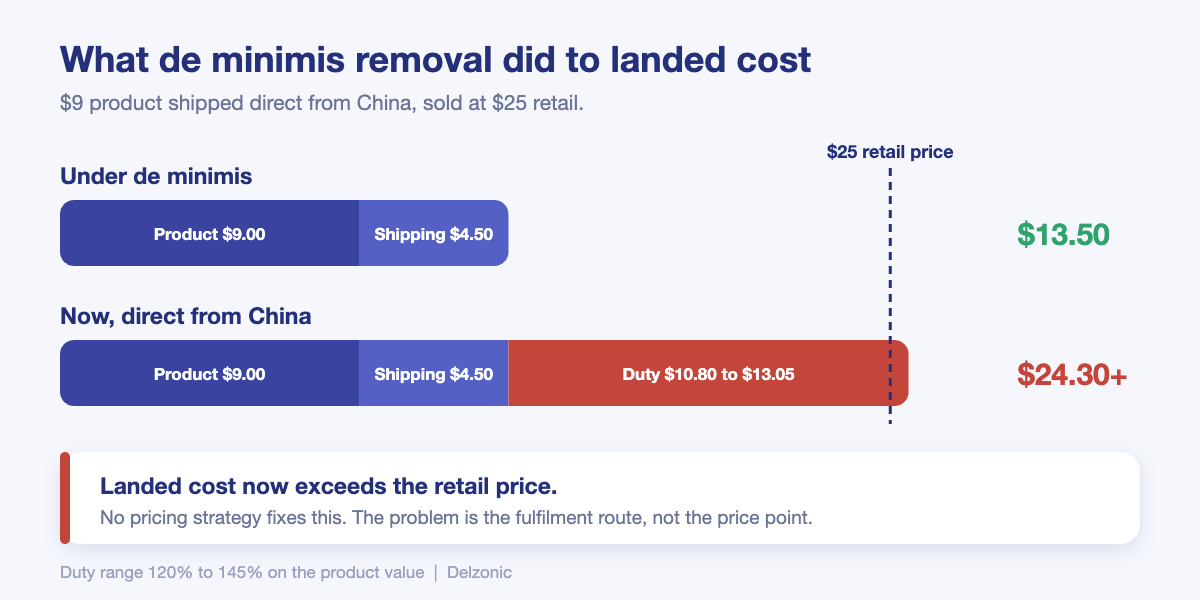
Sellers shipping low-cost goods directly from overseas now face duties of 120% to 145% on small packages from China, or a flat fee of around $100 per item, depending on how the parcel is shipped.
Applied to a real product, the effect is not subtle:
| Line | Under de minimis | Now, direct from China |
|---|---|---|
| Product cost | $9.00 | $9.00 |
| Shipping | $4.50 | $4.50 |
| Duty | $0.00 | $10.80 to $13.05 |
| Total landed cost | $13.50 | $24.30 to $26.55 |
| Viable at a $25 sale price? | Yes | No |
A product that carried a healthy margin now lands above its own retail price. There is no pricing strategy that fixes this, because the problem is the fulfilment route rather than the price point.
Note that the flat-fee option of roughly $100 per item is catastrophic for low-value goods and largely irrelevant for high-value ones, which is why the effect has been concentrated almost entirely at the cheap end of the market.
How has this hit TikTok Shop specifically?
Harder than most platforms, because TikTok Shop’s US growth was disproportionately built on inexpensive, impulse-purchase products fulfilled directly from China. That is precisely the segment de minimis subsidised.
Sales from foreign sellers have fallen since March, with daily sales down as much as 20% to 25% month over month at points during the transition. Buyer sentiment has also been affected, since delivery times lengthened and some buyers encountered unexpected customs charges.
Combined with the August 2026 referral fee increase from 6% to 8%, US sellers absorbed two significant margin events within a short period. Anyone who has not recalculated their unit economics since the summer is almost certainly running products that no longer work.
Verify your classification, not the headline rate
Duty depends on your product’s HTS classification and country of origin, and rates vary widely between product types. The 120% to 145% range is indicative only. A licensed customs broker can give you the number your business actually pays.
What are the options for sellers?
1. Bulk import to a US warehouse
Ship in commercial quantities, clear customs once as a formal entry, and fulfil domestically. Per-unit duty is generally far lower than the per-parcel treatment, and delivery times improve substantially, which helps your On-Time Delivery Rate and Shop Performance Score.
The trade-off is real: you now carry inventory risk and need working capital. This is the route most sellers who stayed profitable have taken, and it changes the business from dropshipping into actual importing.
2. Change sourcing origin
Vietnam, Mexico, India, and Malaysia have absorbed significant volume. Duty treatment differs by country and by product classification, and Mexico in particular offers logistics advantages for US delivery speed.
This is not a drop-in replacement. Supplier quality, minimum order quantities, and lead times all differ, and moving production takes months rather than weeks. Our guide to finding suppliers for TikTok Shop covers vetting.
3. Reprice to absorb the duty stack
Viable only where your product has genuine differentiation and your buyers are not purely price-driven. For commodity items competing against domestic sellers, repricing simply moves you out of the market.
4. Move up in price point
Duty as a percentage hurts cheap goods disproportionately, and the flat-fee route is ruinous for them specifically. Higher-value products absorb duty far more comfortably. Many sellers have shifted their catalogue upward rather than trying to defend the sub-$20 segment.
Most sellers who came through this successfully combined several of these rather than picking one.
What this means for product research
The change reshaped which products are worth selling, and the old intuitions are actively misleading now.
Cheap, light, impulse-buy products from China were the classic TikTok Shop winner. That category is now the worst hit. Meanwhile, higher-ticket products, domestically sourced goods, and categories where US sellers already held inventory have become relatively more attractive, because a large block of low-cost foreign competition left the market.
That last point is the opportunity buried in this. Competition thinned considerably in categories that depended on direct-from-China fulfilment. Sellers positioned to fulfil domestically are competing against fewer listings than they were a year ago.
Finding those categories requires looking at what is actually selling now rather than what worked before. The Delzonic Chrome extension shows live sales volume and competition data on TikTok Shop listings as you browse, and historical data on paid plans lets you see which categories lost competitors during the transition. Post-tariff category dynamics are different enough that research based on pre-2025 assumptions will point you at the wrong products.
Frequently asked questions
Is de minimis coming back?
The suspension was continued by executive order in February 2026. Treat it as the permanent operating environment for planning purposes rather than a temporary disruption to wait out.
Does this affect US-based sellers?
Only on imports. If you already hold inventory in the US, your domestic fulfilment is unaffected, and you benefit from reduced foreign competition. Your restocking costs still change if you import.
Who pays the duty, me or the customer?
It depends on your shipping terms. Delivered Duty Paid means you absorb it. Delivered Duty Unpaid means the customer is billed on delivery, which reliably produces refused parcels, negative reviews, and damage to your Shop Performance Score. Absorbing it into your pricing is the workable option.
Are other countries affected or only China?
De minimis elimination was extended to all countries on 29 August 2025. Duty rates still vary significantly by origin country and product classification, so sourcing origin remains a meaningful lever.
How do I calculate my exact duty rate?
Duty depends on your product’s HTS classification and country of origin. Rates vary widely between product types, so verify your specific classification with a licensed customs broker rather than relying on general ranges. The figures in this article are indicative, not a substitute for professional customs advice.
Pro tip
Never ship Delivered Duty Unpaid to consumers. Billing the buyer on delivery reliably produces refused parcels, negative reviews and Shop Performance Score damage that costs more than the duty you avoided.
The bottom line
De minimis elimination ended the direct-from-China model for cheap goods on TikTok Shop. Sellers who adapted moved to domestic fulfilment, changed sourcing origin, or moved up in price point, and most did some combination of all three.
The upside is that a lot of competition left with it. Categories that were unwinnable two years ago are open to sellers who can fulfil domestically. Delzonic shows you which categories those are, with live sales and competition data rather than assumptions from a market that no longer exists. Start free, and upgrade for historical trends that show exactly how each category shifted.