
Product Research
The TikTok Shop Creator Brief That Actually Converts (2026)
One claim, three things to show, and what not to say. Here is how to brief TikTok Shop affiliates without stripping out the reason you hired them.
Finding winning TikTok Shop products, opportunity scoring, and research strategy.
One claim, three things to show, and what not to say. Here is how to brief TikTok Shop affiliates without stripping out the reason you hired them.
TikTok credits an affiliate sale to the last interaction inside a window. Here is how long those windows are and why two creators claim the same sale.
Creators ask for free product before they promote. Here is how to set sample rules, screen requests, and stop shipping stock to accounts that never post.
TikTok Shop splits GMV into video, LIVE and product card. Here is what each channel means and which one tells you a product is worth selling.
Supplier Center removes the barrier to sourcing and removes your differentiation with it. How it compares to going direct, the margin cost, and how to vet suppliers.
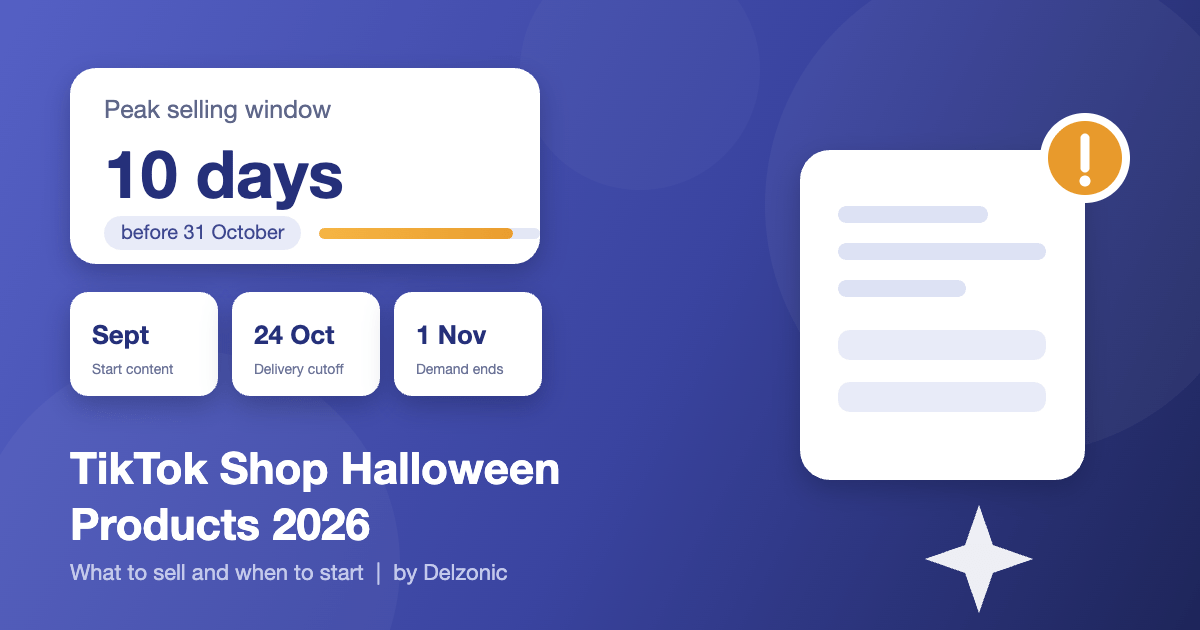
Halloween demand on TikTok Shop builds from mid-September and vanishes on 1 November. The selling calendar, the categories that work, and the mistakes that cost money.
Hunting for low-competition TikTok Shop niches is really a hunt for mismatch: an audience with a genuine problem, and not enough sellers making content about it. Those pockets exist, but they are rarely the categories everyone lists. They tend to sit one or two levels below the obvious category, in sub-niches specific enough that most sellers scroll past them. Here is how to identify one, twelve worth looking at in 2026, and the trade-offs nobody mentions. What Low Competition Actually Means Here On TikTok Shop, competition is not measured by how many listings exist. It is measured by how much creator content already exists for a product type, and how well that content is still performing. A category can have thousands of listings and still be wide open if nobody is filming it. Equally, a category with few listings can be brutally competitive if three creators own all the attention. So the useful question is not how many sellers are here. It is: is creator content in this niche still earning engagement, or has the audience already seen this fifty times? How to Check a Niche Before You Commit Creator coverage Search the product type and count how many distinct creators have posted about it recently. A handful of creators, all with modest followings, is a much better sign than dozens including several large accounts. Engagement trend Look at whether recent videos are still pulling comments and saves or whether performance is visibly declining. Falling engagement on a niche that once worked means you would be arriving late. Our guide on spotting TikTok Shop product saturation covers the warning signs. Price band and margin Low competition is worthless if the niche cannot support your costs. Check whether the price point leaves room for commission, samples and returns using our TikTok Shop profit margin breakdown. Whether it demonstrates The niche has to be filmable. If the benefit cannot be shown in a few seconds, low competition may simply mean nobody found a way to make it work on video. 12 Lower-Competition TikTok Shop Niches for 2026 1. Adaptive and accessibility aids Jar openers, button hooks, easy-grip utensils, dressing aids. Real, persistent demand from an audience that is genuinely underserved by mainstream commerce content, and the demonstration is inherently compelling because the product visibly solves a problem. 2. Pet enrichment and slow feeders General pet supplies are saturated. Enrichment specifically, puzzle feeders, snuffle mats, lick mats, scent games, is a narrower slice with an engaged owner audience and excellent video potential, because the pet does the selling. 3. Small space and dorm organisation Not generic home organisation, which is crowded, but solutions for genuinely constrained spaces: over-door systems, under-bed vacuum storage, bunk bed caddies, tiny bathroom fixes. Strong seasonal spike around move-in periods. 4. Left-handed and ergonomic tools Scissors, notebooks, kitchen tools, mice. A permanently underserved audience that actively seeks these out and shares finds enthusiastically, which is exactly the behaviour you want. 5. Hobby maintenance kits Instrument care, bike drivetrain cleaning, sneaker restoration, fishing reel servicing. Enthusiast audiences with disposable income, low creator coverage, and satisfying before-and-after content built in. 6. Sensory and focus tools for adults The adult market for fidget, focus and sensory regulation products is much less served than the children’s version, and the audience is highly motivated. Content angle is practical rather than novelty. 7. Menopause and midlife wellness Cooling products, sleep aids, comfort clothing. A large, underserved audience with real spending power. Note the compliance care needed on health claims, which is precisely why fewer sellers bother, and precisely why the gap exists. 8. Vehicle-specific interior detailing Generic car cleaning is competitive. Products cut for specific vehicle types, truck bed organisers, van conversion accessories, EV cable management, are not. Owners of those vehicles are loyal, high-intent buyers. 9. Modest and adaptive fashion Layering pieces, adaptive fastenings, longer-cut basics. Fashion overall is crowded, but these sub-niches have committed audiences and comparatively little creator competition. 10. Craft consumables and refills Refills rather than machines. Lower ticket, but repeat purchase is built in and the buyer already owns the equipment, which removes the hardest part of the sale. 11. Format-specific travel accessories Carry-on only packing systems, motorcycle luggage, van-life kit. Broad travel accessories are saturated, but narrow travel formats have communities that follow every recommendation. 12. Problem-specific home fragrance Not scented candles generally, but products aimed at a defined problem: pet odour, cooking smells, damp, gym bags. Problem-led framing converts far better than fragrance-led framing and faces much less competition. Pro tip Pick two or three from this list and validate them properly rather than chasing all twelve. When you land on an interesting product, the free Delzonic Chrome extension scores demand, saturation, creator activity and sentiment directly on the TikTok Shop product page, which turns a long research session into a thirty second check. Niches to Approach With Caution Some categories look low competition because they are difficult rather than overlooked. Supplements and anything with a health claim carry real compliance risk. Electronics with batteries bring shipping and safety restrictions. Anything highly personalised creates a fulfilment burden that scales badly if a video takes off. Low competition is sometimes a warning rather than an opportunity, and it is worth asking why nobody else is there before assuming you have found a gap. Equally, do not confuse low competition with no demand. A niche nobody sells in because nobody wants it is not a niche, it is an empty room. Related Reading TikTok Shop niches to sell in 2026: the full category guide How to find low-competition TikTok Shop products The best converting TikTok Shop categories How to spot trending TikTok Shop products early Best TikTok Shop products under 20 dollars FAQs How do I know if a TikTok Shop niche is really low competition? Count distinct creators posting about the product type recently, not the number of listings. If only a few modest accounts are covering it and their engagement is holding steady or rising, the niche
Knowing how to monitor TikTok Shop products over time is what separates sellers who catch trends from sellers who read about them afterwards. A one-off research session tells you where a product stands today. Monitoring tells you which direction it is moving, and direction is the only part that predicts whether entering will make you money. Why Snapshots Fail and Watchlists Work Most product research is done as a single deep session: hours of browsing, a shortlist, a decision. The problem is that every number you collect in that session is a level, not a trend. A product with strong sales might be climbing or might have peaked three weeks ago, and a snapshot cannot tell you which. Monitoring solves this cheaply. Checking twenty products for two minutes each, once a week, produces a far more useful picture than one exhaustive session, because after three weeks you have direction on all twenty. That is the difference between guessing and knowing. What to Track on Each Product Keep the list short enough that a weekly check stays realistic. These are the signals that actually move a decision. Signal What it tells you Warning sign Recent sales direction Whether demand is live or fading Flat or falling for two weeks running Number of shops listing it How fast competition is arriving Sharp jump in near-identical listings Price of the cheapest listing Whether margin is being competed away Steady week-on-week decline New video performance Whether the algorithm still distributes it Recent videos all underperforming older ones Review velocity Whether buying is ongoing Reviews thinning out noticeably Creator count Whether new promoters keep joining Same few accounts, no newcomers Six signals, checked weekly, on a fixed list. That is the whole method. Our product lifecycle guide explains how these signals map onto the stage a product has reached. Building Your Watchlist Keep it to a manageable size Twenty to thirty products is a good working range. Small enough to review in half an hour, large enough that something interesting is usually happening somewhere on the list. Mix the stages deliberately Include products you are considering buying, products you already sell, and one or two competitor bestsellers you have no intention of selling. The last group is the most useful, because watching a proven product teaches you what a healthy trend line looks like in your category. Refresh it regularly Remove anything that has clearly declined and add new candidates as you find them. A stale watchlist becomes a chore, and a chore gets skipped. Tools That Make This Practical Monitoring only works if the weekly check is genuinely quick. If it means manually opening thirty listings, recording numbers in a spreadsheet and comparing them to last week’s tab, you will do it twice and then stop. The Delzonic Chrome extension is built for exactly this pattern. It shows product, shop, video and creator analytics directly on TikTok Shop pages, and its Favorites feature lets you save products to a monitored list so you can review your shortlist without rebuilding it each time. Because it works on the pages you are already browsing, the weekly check stays short enough to actually happen. More detail is at delzonic.com, and our step by step walkthrough covers the workflow. Whatever you use, the requirement is the same: it must be fast enough that a weekly review takes minutes, and it must let you compare a product against its own past rather than only against the market. A Weekly Routine That Takes 30 Minutes Minutes 1 to 10: Run through the watchlist and note direction only, up, flat or down, for sales and price. Do not analyse yet. Minutes 11 to 20: Look closely at anything that changed direction this week. A product that flipped from flat to rising is the most valuable thing on your list. Minutes 21 to 25: Add two or three new candidates from browsing a category you understand. Minutes 26 to 30: Remove anything clearly in decline and write down one decision: something to test, source, scale or drop. The final step matters most. Monitoring without a decision at the end is just collecting data. Force one action per week, even a small one. Monitoring Your Own Products Too The same routine applies to what you already sell, with one addition: watch your competitors on your own products. A new shop undercutting you, or a competitor listing gaining reviews faster than yours, is something you want to notice in week one rather than in month two when your sales have already slipped. Combine this with your Seller Center numbers rather than replacing them. Internal data tells you what happened to you, monitoring tells you what happened around you, and you need both to interpret either. Our analytics guide and the eight metrics worth tracking cover the internal side. What to Actually Do With What You Find Monitoring produces observations, and observations only pay when they turn into decisions. Four patterns come up repeatedly, and each has a clear response. A watchlist product flips from flat to rising. This is the highest-value signal you will get. Move it to the front of your sourcing queue and start pricing it with suppliers immediately, because the gap between noticing and listing is what determines your margin. A product you sell starts attracting copycat listings. Do not respond with a price cut by reflex. Strengthen the listing, build review volume and consider a bundle first. Price is the last lever, not the first. The cheapest listing on a product you sell keeps dropping. Check whether your margin still survives at the new market level. If it does not, plan an exit rather than following the price down. A category you watch goes quiet across the board. Treat this as a signal to widen your research rather than to push harder into a fading space. Write the decision down each week, even when the decision is deliberately to do nothing. A short written record turns a vague sense
The best TikTok Shop products under $20 share one thing: they convert on impulse, without the buyer needing to research, compare or think about it. That is precisely what TikTok Shop is built for, and it is why this price band consistently produces high order volumes. The catch is that low tickets are unforgiving on margin, so choosing well matters more here than in any other price range. Why the Under $20 Band Works So Well TikTok Shop sells to people who were not shopping. Someone scrolling their feed sees a product, decides in seconds and checks out inside the app. Every extra second of consideration costs conversions, and price is the single biggest driver of consideration time. Under roughly $20, most buyers do not open another tab to compare prices, do not read a dozen reviews and do not save the video for later. Above it, they increasingly do all three. That behavioural line is why this band is where most first-time TikTok Shop sellers find traction fastest. Product Categories That Perform in This Range These are the category patterns that reliably work under $20, rather than specific items that will be saturated by the time you read this. Category Why it works under $20 Watch out for Beauty tools and accessories Visible before and after in seconds Crowded, needs a differentiated angle Kitchen gadgets Obvious problem and instant demo Quality complaints hurt review scores Home organisation Satisfying transformation content Bulky items destroy shipping margin Phone and tech accessories Universal need, easy to demo Compatibility questions drive returns Pet accessories Strong emotional pull, repeat buyers Sizing issues cause returns Cleaning products Best before and after content on the platform Liquids can face shipping restrictions Stationery and desk items Cheap, giftable, highly visual Very low margin per unit Car accessories Clear practical benefit Fit and compatibility complaints For a broader view of what is selling right now, see the best TikTok Shop products to sell and bestsellers broken down by category. What Makes a Good Under $20 Product It demos in under three seconds. If you need to explain it, the price band is working against you rather than for you. It solves a small, specific annoyance. Not a life-changing problem, just a recognisable one. Recognition is what stops the scroll. It is small and light. Shipping cost is a much larger share of a low ticket than of a high one, so size directly determines whether the maths works. It is hard to get badly wrong. Fewer sizes, fewer variants and fewer compatibility questions mean fewer returns, and returns are brutal at this price. It bundles naturally. The reliable path to profitability under $20 is raising average order value rather than raising price. The Margin Problem, and How to Solve It At a $15 selling price, fixed costs that would be trivial on a $60 product become decisive. Packaging, outbound shipping, platform commission and affiliate commission all take a proportionally larger bite, and a single return can erase the profit from several orders. Three approaches genuinely work here: Bundle from the start. Sell two or three units together, or pair a hero item with a low-cost complement. See how to build bundles that raise order value. Set a free shipping threshold slightly above your single-unit price. This nudges buyers toward a second item without discounting. Be ruthless about size and weight. A cheaper product that ships in a light mailer often out-earns a better product that needs a box. Model this properly before you buy stock. Our profit margin guide lists every cost line to include, and the fees breakdown covers the platform side. How to Find Products in This Band Yourself Published lists are useful for understanding patterns and close to useless for picking your next product, because anything on a public list is already being sold by everyone who read it. The durable approach is to learn the pattern and then find current examples yourself. Browse a category you understand, filter mentally for items that demo instantly and ship light, then check whether demand is actually rising rather than fading. The Delzonic Chrome extension shows product, shop, video and creator analytics on the TikTok Shop pages you are already viewing, so you can check demand signals on a candidate without leaving the listing, and save promising items to Favorites to watch them over the following weeks. Then apply the standard screen: is the trend rising, how many shops already sell it, and does the margin survive a realistic return rate. Our winning product checklist puts that into a repeatable order. Common Mistakes at This Price Point Competing purely on price. Under $20 there is very little room beneath you, so a price war ends quickly and badly. Ignoring shipping weight during sourcing. The most common reason a cheap product turns out to be unprofitable. Layering affiliate commission onto an already thin margin. Build creator commission into the price before launch, not after. Treating a low price as a substitute for good content. Cheap products still need a hook. Price lowers resistance, it does not create desire. Pricing and Bundling in the Under $20 Band Because there is so little room beneath you at this price, pricing decisions here are really packaging decisions. Three structures do most of the work. The multi-pack. Sell two or three units as the default option with a modest per-unit saving. Shipping and packaging costs barely change, so almost all the extra revenue is margin. This is the single most effective move available in this band. The hero plus complement. Pair the item people came for with a genuinely useful low-cost extra. The buyer perceives added value, and your cost of adding it is small relative to the price uplift. The free shipping threshold. Set it just above your single-unit price so a buyer taking one item is nudged toward two. This raises average order value without discounting anything. What generally does not work is a straight price cut. At this level
Deciding how many products to test on TikTok Shop is one of the few choices that changes almost everything downstream: your cash requirement, your content workload, and how quickly you find something that works. Test too few and you are betting your whole shop on a single guess. Test too many and none of them get enough content to prove anything. This guide covers how to size a testing plan you can actually execute. Why the Number Matters More Than the Products Product testing on TikTok Shop is a numbers game with a hard constraint attached. The numbers game part is straightforward: most products fail, so you need enough attempts to find a winner. The constraint is that every product needs content to be tested at all, and content capacity is finite. A product that gets three videos has not been tested. It has been mentioned. If you list ten products and can only make fifteen videos a week, you are giving each product roughly one and a half videos, which is far too thin to distinguish a bad product from a bad hook. Start With Content Capacity, Not Product Count Work backwards. Decide realistically how many videos you can produce per week, then divide by the number of videos a fair test needs. Most sellers find a product needs somewhere between eight and fifteen videos across different hooks before the result means anything, because a single flat video usually says more about the hook than the product. Videos you can make weekly Products to test at once Rough time per test cycle 5 to 7 1 2 weeks per product 10 to 14 2 2 weeks per pair 20 to 30 3 to 4 2 weeks per batch 40 or more, or using creators 5 to 8 1 to 2 weeks per batch These are planning guides rather than rules. The principle underneath them is fixed: never list more products than you can give a fair content budget to. How Long a Test Should Run Two weeks is a sensible default for most products. That is long enough for the algorithm to find an audience for at least one video, and short enough that you are not sitting on dead stock while you wait. Two exceptions are worth knowing. First, if one video takes off early, extend the test rather than ending it on schedule, because you now have a live signal worth pushing. Second, if a product is highly seasonal, run the test inside its season or the result tells you nothing useful. Do not judge a test on a single day. Daily numbers at low volume are mostly noise, which our analytics guide goes into in more detail. What Counts as a Pass or a Fail Define the outcome before you start, otherwise you will rationalise whatever happens. A clear test plan states in advance what you expect to see. Clear pass: multiple videos generating clicks, orders arriving from more than one video, and margin holding at the price you tested. Partial pass: strong video performance but weak conversion. The product may be fine and the listing may be the problem, so fix the listing and retest before discarding it. Clear fail: consistently low click-through across varied hooks. When several genuinely different angles all fail, the product is the issue. Inconclusive: too few videos, or all videos used the same hook. This is not a result, it is an incomplete test. The partial pass case is where most sellers lose money, because they kill a viable product over a fixable listing. If that pattern sounds familiar, work through the common causes of a shop not getting sales first. Keep the Cost of a Test Low The point of testing is to learn cheaply. A few practical ways to keep the cost down: Order small quantities. Buy enough to fulfil an optimistic test, not an optimistic launch. Test products from the same supplier together. One shipment, several tests, lower cost per test. Reuse content structures. A hook that worked for one product often adapts to another, which cuts filming time significantly. Do the research before the test. Screening out obviously weak products beforehand is the cheapest filter available. Use the winning product checklist and product validation steps. That last point is the highest-leverage one. The Delzonic Chrome extension shows product, shop, video and creator analytics directly on TikTok Shop, and its Favorites feature lets you keep a shortlist of candidates under observation before any of them cost you money. Fewer weak products reaching the testing stage means more of your content budget goes to products that might actually win. How Many Tests Before You Should Expect a Winner Nobody can give you an honest exact number here, because it depends heavily on category, sourcing quality and content skill. What is broadly true is that experienced sellers expect most tests to fail and plan cash accordingly. If you budget for one test and treat a failure as a disaster, you will make bad decisions under pressure. The healthier framing is a rolling pipeline: something always in test, something always in research, and something always scaling. That removes the pressure on any single product and makes results arrive steadily rather than in anxious bursts. When to Stop Testing and Scale Once a product passes cleanly, the mistake is to keep treating it like a test. Shift budget and content toward it, deepen the listing, bring in creators, and stop splitting attention across weaker candidates. Scaling a proven product is almost always a better use of the next hundred videos than starting a new test. See how to increase sales and our live selling guide for the next steps. Related Reading Read the complete product research guide, explore low competition products, review common seller mistakes, and check the best products for beginners. FAQs How many products should a beginner test on TikTok Shop? One or two at a time is usually right for a beginner, because content capacity is the