
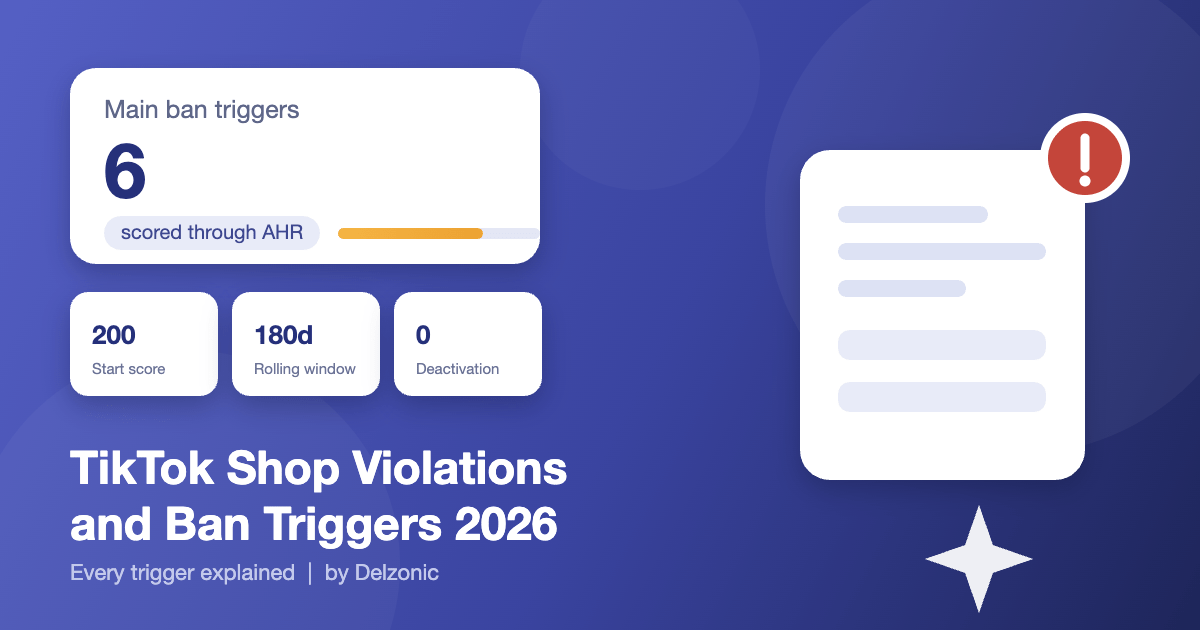
Short answer: Most TikTok Shop bans trace back to a short list of triggers: prohibited or restricted products, intellectual property complaints, misleading listings, fulfilment failures, and unsubstantiated claims. Since July 2026 these are scored through Account Health Rating, which replaced the old Violation Points system. New shops are the most exposed, because every account starts at 200 points with no cushion above the Healthy threshold.
How TikTok Shop enforcement works in 2026
Enforcement runs through Account Health Rating, a 0 to 1,000 score assessed over a rolling 180-day window. Violations subtract points scaled to severity and frequency. Enforcement escalates as you cross 150, 100, 50, and finally 0, at which point the shop is deactivated.
The practical consequence is that bans are almost never sudden. They are the end of a sequence that began with a violation the seller did not notice. If you are reading this after a restriction, our guide on recovering a restricted TikTok Shop account covers the next steps. For how the scoring itself works, see our full Account Health Rating guide.
The main triggers for violations and bans
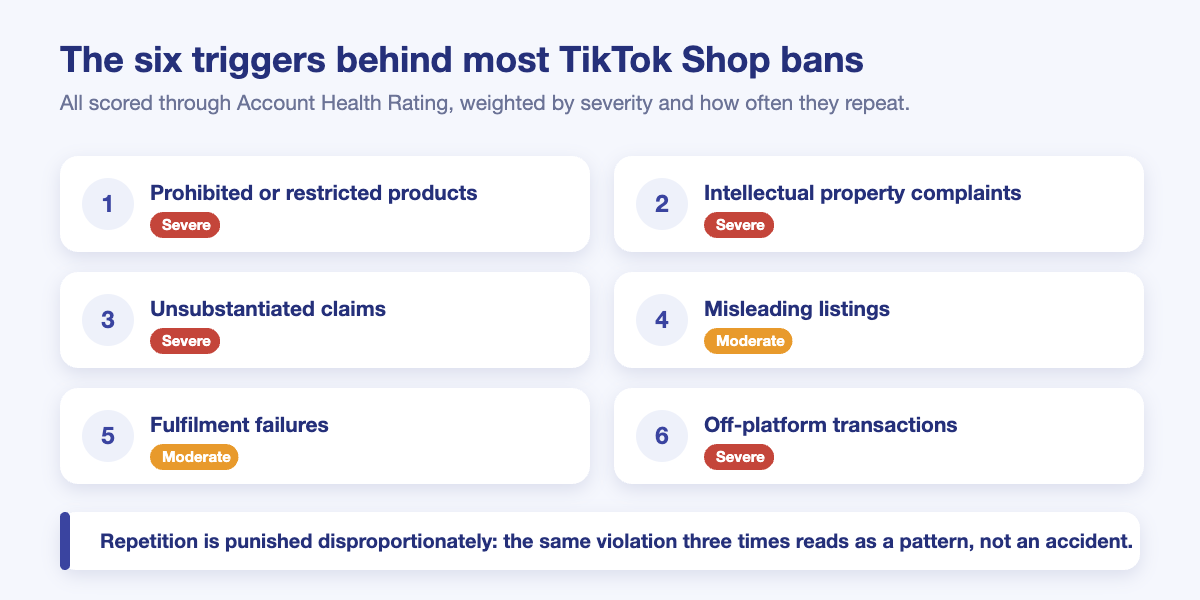
1. Prohibited and restricted products
The single largest cause of severe deductions. Two distinct mistakes sit here. Listing something outright banned is obvious. The more common error is listing in a restricted category without holding the required qualification, which sellers frequently do without realising the category was gated. Check the current list in our guide to what you cannot sell on TikTok Shop.
2. Intellectual property complaints
Counterfeit reports, unlicensed brand names in titles, and using another seller’s product photography. IP complaints are filed by rights holders rather than detected by TikTok, which means they arrive without warning and are weighted heavily. Dropshippers using supplier-provided images are particularly exposed, because those images are frequently reused across dozens of listings.
3. Misleading listings
Inaccurate titles, wrong category placement, images that do not match the product, and specification claims you cannot support. Category misplacement is worth calling out separately, because sellers sometimes do it deliberately to reach a lower referral fee band. That is treated as a violation and costs far more than the fee saved.
4. Fulfilment failures
Late dispatch, high seller-fault cancellation rates, and invalid or recycled tracking numbers. Uploading placeholder tracking to stop a dispatch clock is a specific and well-detected pattern.
5. Unsubstantiated claims
Health, medical, income, and safety claims you cannot evidence. This catches supplement, skincare, and wellness sellers most often, and applies to your video content as well as your listing text.
6. Off-platform transaction attempts
Directing buyers to complete purchases elsewhere, including contact details in listings or packaging inserts pushing buyers to another store.
Why new shops get banned fastest
Every account starts at 200 points, which is also the bottom of the Healthy tier. A new shop therefore has zero buffer. One severe violation in the first weeks drops you straight into Needs Improvement, and a second can reach enforcement territory before you have made meaningful revenue.
Established shops absorb the same mistake far better, both because they have accumulated points from completed orders and because a single violation is a smaller share of their recent history. Treat compliance as a launch task, not something to tidy up once sales start.
Your own images are the cheapest insurance
Supplier-provided photography gets reused across dozens of listings, which is exactly what makes it an intellectual property target. Shooting your own product images removes the most common complaint route for dropshippers.
How to keep your account safe
- Check the category rules before you list, not after. Most severe deductions are product-selection errors that were entirely avoidable at the research stage.
- Use your own product images. This single change eliminates the most common IP complaint route for dropshippers.
- Open your Account Health page weekly. Appeal windows are time-limited, and email notification is not reliable enough to depend on.
- Appeal anything incorrect immediately. A successful appeal removes the deduction rather than merely offsetting it.
- Take the policy quizzes. They credit points back and take minutes.
- Never upload placeholder tracking. It converts a minor late-dispatch issue into a serious integrity violation.
Choosing products that do not invite violations
You cannot receive an IP strike on a product you never listed. The highest-leverage compliance decision happens during research, before any listing exists.
Categories crowded with near-identical low-cost listings are where counterfeit reports and listing disputes concentrate, because rights holders monitor them and competitors report each other. The Delzonic Chrome extension shows live sales and competition data on TikTok Shop listings while you browse, so you can see how saturated and brand-adjacent a category is before committing inventory to it.
Frequently asked questions
How many violations before a TikTok Shop ban?
There is no fixed count. Under Account Health Rating, deactivation happens at 0 points, and how quickly you get there depends on violation severity and frequency rather than a simple tally.
Can a banned TikTok Shop be recovered?
Reactivation at 0 points is at TikTok Shop’s sole discretion. Treat deactivation as permanent when planning.
Do violations expire?
Account Health Rating uses a rolling 180-day window, so deductions age out roughly six months after they occur.
Will one violation get me banned?
Very unlikely on its own, but a severe violation on a new shop with no point cushion can move you into a warning tier immediately.
What is the most common cause of TikTok Shop bans?
Prohibited and restricted product listings, followed by intellectual property complaints. Both are decided by what you choose to sell.
Pro tip
Never upload placeholder tracking to stop a dispatch clock. It converts a minor late-dispatch problem into a serious integrity violation, and the pattern is well detected.
The bottom line
Bans are the endpoint of an ignored sequence, not a bolt from the blue. Sellers who check Account Health weekly, appeal fast, and avoid categories that attract complaints rarely reach enforcement at all.
The cheapest compliance work happens before you list. Delzonic gives you the sales and competition data to choose products deliberately. Start free, and upgrade for historical trends and deeper category analysis.