
TikTok Shop IP Protection 2026: TikTok Real and Brand Complaints
Short answer: Intellectual property complaints are the fastest way to lose a TikTok Shop account, because they are filed by rights holders rather than detected by TikTok, so they arrive with no warning and are weighted heavily under Account Health Rating. In 2026 TikTok launched TikTok Real, a brand portal that lets rights holders report counterfeits and listing violations directly to platform safety teams. For sellers, that means enforcement is getting faster, not slower.
What is TikTok Real?
TikTok Real is an intellectual property protection initiative introduced in 2026, presented at the International Trademark Association reception that year. It gives brands a dedicated portal to communicate directly with TikTok’s platform safety teams, flag counterfeit items, and report listing violations.
The practical shift is speed and routing. Previously an IP complaint went through general reporting channels and competed with everything else in the queue. A dedicated brand portal shortens that path considerably.
If you sell anything brand-adjacent, assume complaints now get actioned faster than they did last year, and plan accordingly.
Why IP complaints hurt more than other violations
Three reasons, and they compound.
- They are externally filed. Most policy violations are detected by TikTok’s own systems, which means there is often a pattern of warnings first. An IP complaint arrives whenever a rights holder decides to file one.
- They are weighted heavily. Under Account Health Rating, deductions scale with severity, and counterfeit and trademark issues sit at the top of that scale.
- They repeat. Rights holders monitor categories continuously. A seller who draws one complaint in a category usually draws several, and repetition is punished disproportionately.
The complaint usually is not about your product
Most IP strikes against small sellers are triggered by the listing rather than the item: a brand name used as a keyword, a comparison claim in the title, or supplier photography that belongs to someone else. The product can be entirely legitimate and the listing can still be infringing.
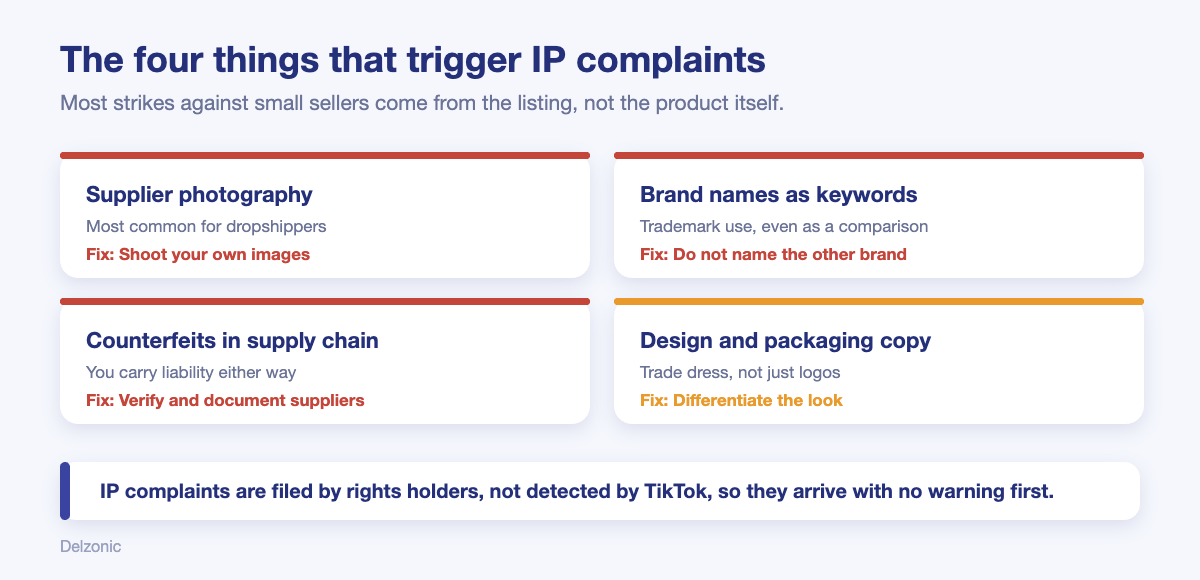
The four things that actually trigger IP complaints
1. Supplier photography
The single most common cause for dropshippers. Supplier images are reused across dozens of listings, which makes them trivial for a rights holder or competitor to find, and the copyright usually belongs to whoever shot them rather than to you. Shooting your own images removes this entire category of risk in one step.
2. Brand names used as keywords
Putting a designer or brand name in your title to catch search traffic is trademark use, even when the product is described as an alternative. Comparison phrasing is safer than direct naming, but the safest position is not naming the other brand at all.
3. Counterfeit goods entering your supply chain
Cheap wholesale is a known route for fakes, and you carry the liability whether or not you knew. Verifying suppliers and keeping purchase documentation is the only real defence, and it is also the evidence you need for an appeal.
4. Design and packaging similarity
Trade dress covers distinctive packaging and product shape, not just logos. A product that copies the look of a well known one attracts complaints even when nothing is branded.
How to protect your own brand
If you are the rights holder rather than the reseller, the same infrastructure works in your favour.
| Step | What it does | Worth doing when |
|---|---|---|
| Register the trademark | Gives you standing to file at all | Before you scale, not after |
| Use the brand portal | Direct line to platform safety teams | You have a registered mark |
| Own your product imagery | Makes copies easy to prove | Always |
| Distinctive packaging | Extends protection beyond the logo | Your category is easy to copy |
| Monitor your category weekly | Catches copies before they scale | You are selling well enough to copy |
Registration is the gate. Without a registered mark most reporting routes are closed to you, and the practical consequence is watching copies outsell you with no mechanism to stop it.
What to do if a complaint is filed against you
- Take the listing down first. Arguing while the listing is live increases exposure. You can restore it if the complaint fails.
- Work out which of the four triggers applies. Image, keyword, counterfeit, or trade dress. The remedy differs for each.
- Appeal with documents, not explanations. Invoices, supplier authorisation, brand permission, and proof you own the imagery are what change outcomes. Narrative does not.
- File within the window. Appeals are time limited, and a valid appeal filed late is worth nothing.
- Audit the rest of your catalogue. If one listing had the problem, others usually do too, and fixing them before the next complaint is far cheaper than after.
Our guide to violations and ban triggers covers how the deduction is scored, and the restricted account guide covers recovery if enforcement has already started.
Pro tip
Before listing anything brand-adjacent, search the product on TikTok Shop and look at how long the existing listings have been up. A category full of listings under two weeks old often means older ones were removed, and that is a takedown pattern rather than a fresh trend.
Choosing products that do not attract complaints
Every point above is cheaper to handle at the research stage than at the enforcement stage. You cannot receive a complaint about a product you never listed.
Categories crowded with near-identical low-cost listings are where complaints concentrate, because rights holders monitor them and competitors report each other. The Delzonic Chrome extension shows live sales and competition data on listings as you browse, so you can see how saturated and brand-adjacent a space is before committing inventory to it.
Frequently asked questions
What is TikTok Real?
An intellectual property protection initiative TikTok introduced in 2026, including a portal that lets brands report counterfeits and listing violations directly to platform safety teams.
How many IP complaints before a TikTok Shop ban?
There is no fixed number. Under Account Health Rating, deductions scale with severity and repetition, and IP issues carry heavy weighting, so a small number can move you into enforcement quickly.
Are dupes and inspired-by products allowed?
Selling a product inspired by another is generally lawful where no trademark, logo, or protected trade dress is copied. Using the original brand’s name or packaging is not. The listing is usually what creates the infringement, not the product.
Can I use supplier images if the supplier says it is fine?
Only if the supplier actually owns them and grants you rights in writing. Many do not own the images they distribute. Your own photography is the reliable answer.
Do I need a registered trademark to report copies?
For most brand protection routes, yes. Registration is what gives you standing to file.
The bottom line
IP enforcement on TikTok Shop got faster in 2026, and the sellers most exposed are the ones using supplier images in brand-adjacent categories. Both are fixable, and both are cheaper to fix before a complaint than after.
Shoot your own images, avoid naming other brands, verify your suppliers, and choose categories that do not invite complaints in the first place. Delzonic gives you the competition data to make that last choice deliberately. Start free, and upgrade for historical trends that show how a category has actually behaved.