
TikTok Shop vs YouTube Shopping 2026: Which Should You Sell On?
Short answer: TikTok Shop is easier to enter and converts faster. YouTube Shopping is harder to qualify for and converts slower, but the content keeps earning for years instead of days. TikTok Shop affiliates need around 1,000 followers. YouTube Shopping affiliates need 500 subscribers plus YouTube Partner Program membership, a requirement tightened in March 2026. Most sellers should not choose between them, they should sequence them.
The core difference: demand creation versus demand capture
TikTok Shop creates demand. Nobody opens TikTok intending to buy a silicone spatula. They see a video, want the thing, and buy inside sixty seconds. That produces enormous impulse volume and near-zero purchase intent before the video.
YouTube Shopping captures demand more often than it creates it. Someone searching “best standing desk under $300” already intends to buy. The video does not create the want, it decides where the money goes. Conversion per view is lower, but intent per viewer is far higher.
This single difference explains almost every other contrast between the two.
Requirements and access compared
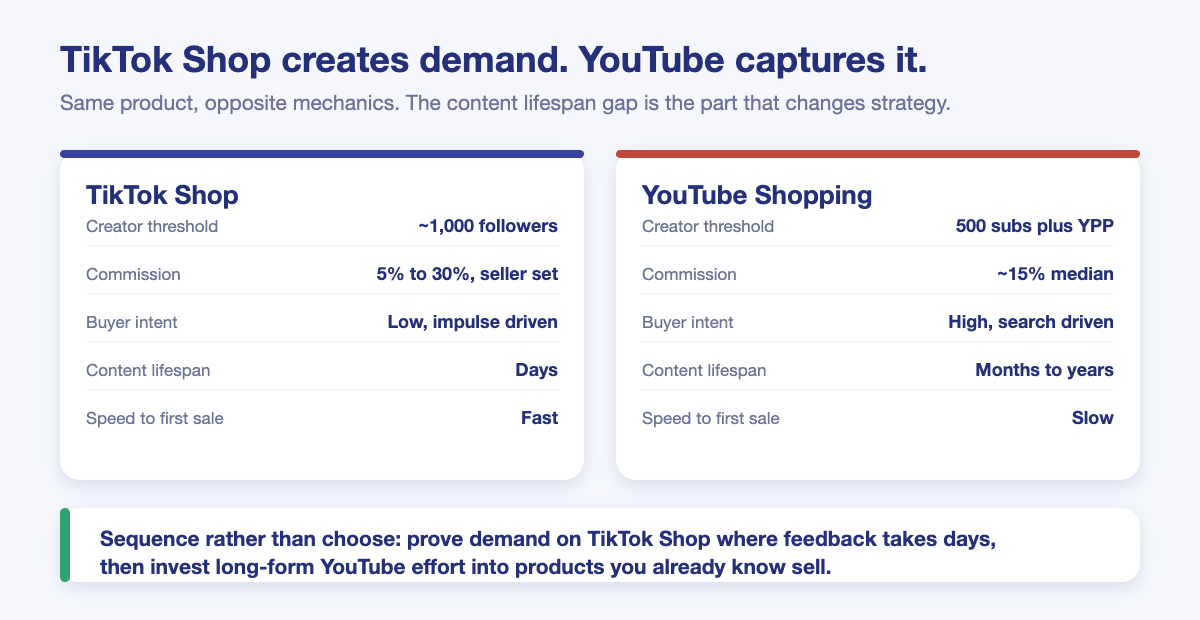
| TikTok Shop | YouTube Shopping | |
|---|---|---|
| Creator threshold | ~1,000 followers | 500 subscribers plus YPP membership |
| Typical commission | 5% to 30%, seller set | Around 15% median, roughly 10% lower quartile |
| Open vs targeted rates | 10-15% open, 18-50% targeted | Set by brand programme |
| Content lifespan | Days | Months to years |
| Buyer intent | Low, impulse driven | High, search driven |
| Typical price point | Lower, impulse band | Higher, considered purchases |
| Speed to first sale | Fast | Slow |
The access gap is deliberate. YouTube tied Shopping affiliate eligibility to Partner Program membership in March 2026, which raised the bar meaningfully. TikTok Shop remains the lower barrier of the two.
The content lifespan gap is the real story
A TikTok video earns almost everything it will ever earn in its first 72 hours. A YouTube review can still be driving sales two years later. That changes what each platform is worth per hour of production, and it is why creators who master YouTube stop needing to post daily.
Which platform suits which product?
TikTok Shop wins on
- Visual, demonstrable products. A visible transformation in fifteen seconds is the whole mechanism.
- Impulse price points. Roughly $15 to $50, where nobody leaves to research.
- Trend-sensitive categories. Speed to market matters more than depth of information.
- Low decision risk. No sizing, no compatibility questions.
YouTube Shopping wins on
- Considered, higher-ticket purchases. Buyers who want ten minutes of detail before spending $200.
- Technical products. Anything with specifications people compare.
- Products with a long shelf life. If the product will still exist in two years, the video keeps working.
- Categories where trust carries the sale. Long-form builds credibility that short-form cannot.
How the economics actually differ
Compare a $40 product on both, assuming the same creator effort.
On TikTok Shop the video might reach 200,000 views in three days, convert at a low single digit rate on the fraction that see the product card, and then stop. Income is front-loaded and finished within a week.
On YouTube the same product in a comparison review might reach 20,000 views over six months, convert at a much higher rate because the viewer searched for it, and continue at a slow trickle afterwards. Fewer views, far more revenue per view, spread over a much longer period.
Neither is better in the abstract. TikTok Shop pays you sooner and YouTube pays you longer. For a seller with cash flow pressure, sooner usually wins. For one building an asset, longer does.
Should sellers run both?
Usually yes, but not simultaneously from a standing start. The sequence that works is TikTok Shop first, YouTube second.
TikTok Shop tells you quickly whether people want the product at all, because the feedback loop is days rather than months. Once a product is proven there, a YouTube review becomes worth producing, since you are investing long-form effort into something with demonstrated demand rather than a guess.
Doing it the other way round means spending weeks on a detailed review for a product that may not sell.
Pro tip
If you expand to YouTube, do not re-cut your TikTok content. The formats reward opposite things. TikTok punishes context and rewards immediacy. YouTube rewards the context TikTok made you strip out, and viewers notice repurposed short-form instantly.
How to pick products that work on either
Whichever platform you start with, the product decision comes first, and both punish the same mistakes: no demand, too much competition, or margin that does not survive the fee stack. Our 2026 fee guide covers what TikTok Shop now takes.
The Delzonic Chrome extension shows live sales volume and competition on TikTok Shop listings while you browse, which is the fastest way to validate demand before committing to either platform. Our product research guide covers the full screening method, and the commission rates guide covers what to offer creators.
Frequently asked questions
Is YouTube Shopping better than TikTok Shop?
Not better, different. TikTok Shop converts faster on impulse products at lower price points. YouTube Shopping converts higher-intent buyers on considered purchases and keeps earning long after publication.
What are the YouTube Shopping affiliate requirements in 2026?
500 subscribers plus YouTube Partner Program membership. The Partner Program tie was added in a March 2026 update, making it stricter than before.
Which pays higher commission?
It depends on the deal rather than the platform. TikTok Shop targeted collaborations can reach 18% to 50%, while open collaborations typically run 10% to 15%. YouTube Shopping commissions cluster around a 15% median.
Can I sell the same product on both?
Yes, and most sellers should. Just produce different content for each rather than reposting.
Which should a beginner start with?
TikTok Shop, because the follower threshold is lower and the feedback loop is days rather than months. Add YouTube once a product has proven demand.
The bottom line
TikTok Shop is a demand engine with a short memory. YouTube Shopping is a slower channel that compounds. The sellers who do well on both use TikTok to find out what people want and YouTube to keep selling it once they know.
Either way the product decides the outcome. Delzonic shows you what is actually selling and how crowded it is before you build content around it. Start free, and upgrade for the historical trends that show whether demand is durable or just a spike.